Assess Quantum Risks
You can check your website, code, or questionnaire answers to see where quantum-related risks may appear.
Preparing organizations for the quantum era through awareness, assessment, and defense-in-depth mitigation.
Vulnerable encryption may no longer protect your data, identities, and critical systems.
You can check your website, code, or questionnaire answers to see where quantum-related risks may appear.
Based on that, you receive a quantum readiness score and get clear standards-supported guidance on what to do next.
Finally, you can try defense-in-depth strategies and see how they can support post-quantum resilience.
Organizations are not prepared for quantum cybersecurity challenges
“The transition to post-quantum cryptography will be a complex, multi-year process. OT owners and operators cannot wait until the advent of a CRQC to develop and implement a plan.”
Mid-sized orgs are not ready for quantum cybersecurity challenges
Onyx is built for people who code, teams working with Operational Technology (OT), and anyone who wants to understand quantum cyber risks.
Hover over each target to learn how Onyx can support different users and teams.
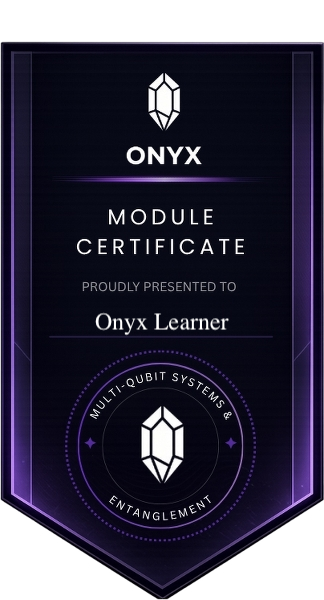
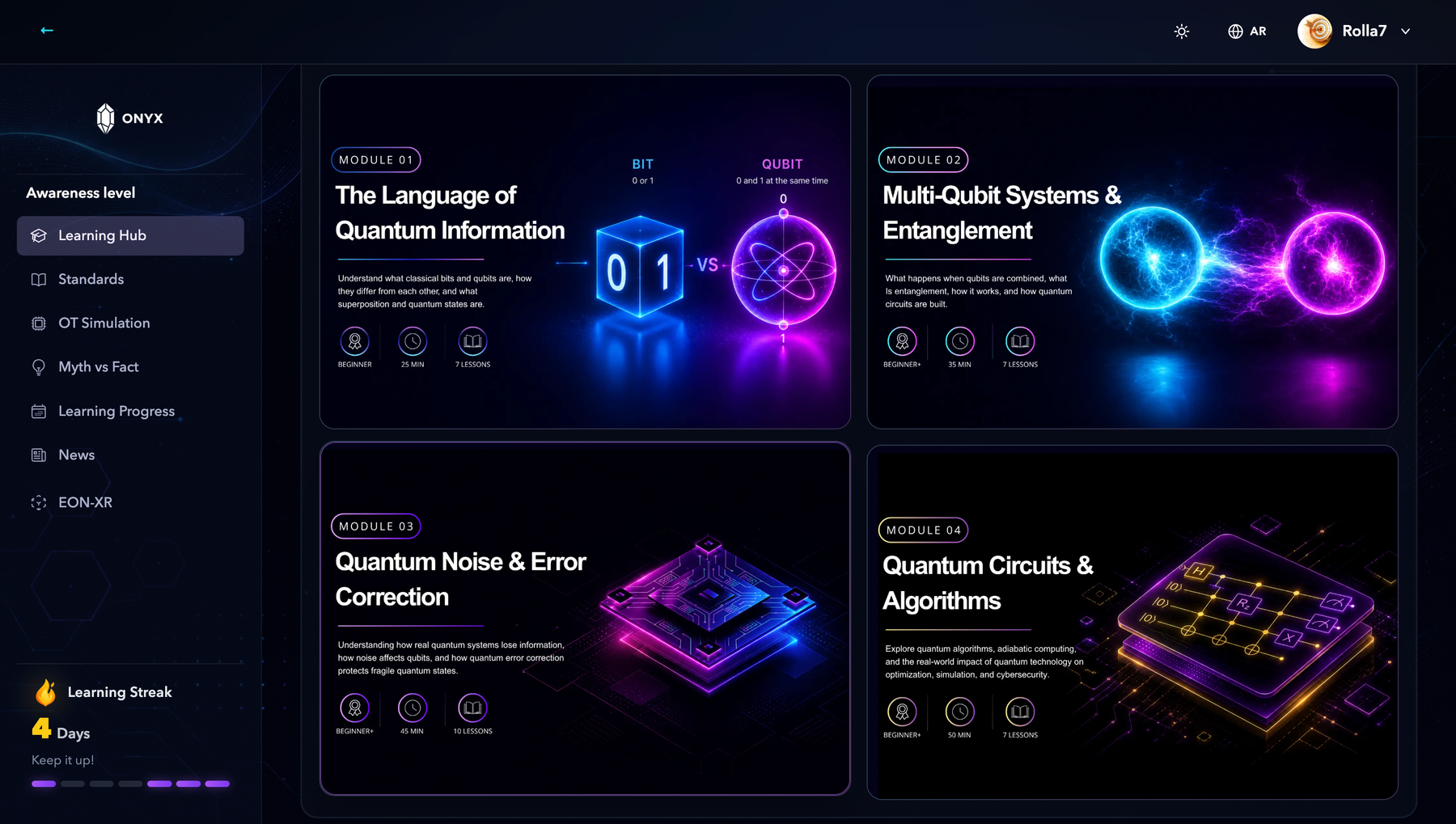
Quantum Computing is rarely a topic that is addressed in school or universities. Students can learn Quantum Computing by completing modules and earn badges as a result.
Vibe coding helps people build faster, but security posture can be unclear. General AI may miss quantum-security risks if users do not know to ask.
Cyber specialists can learn about cryptography and also use Onyx to evaluate exposure, identify weak domains, and map findings to recognized standards.
In the mitigation layer, they can benefit from understanding how defense-in-depth increases quantum attack crack time. More research coming up to include in Onyx!
Our main target is the Operational Technology field too, where critical infrastructures can benefit from both awareness and assessment layers.
Software engineers can benefit by identifying quantum-related risks in codebases and websites, or can include it within a proactive process in software maintenance.
Learn Quantum & OT. Discover Standards.
Explore simulations & stay up-to-date.
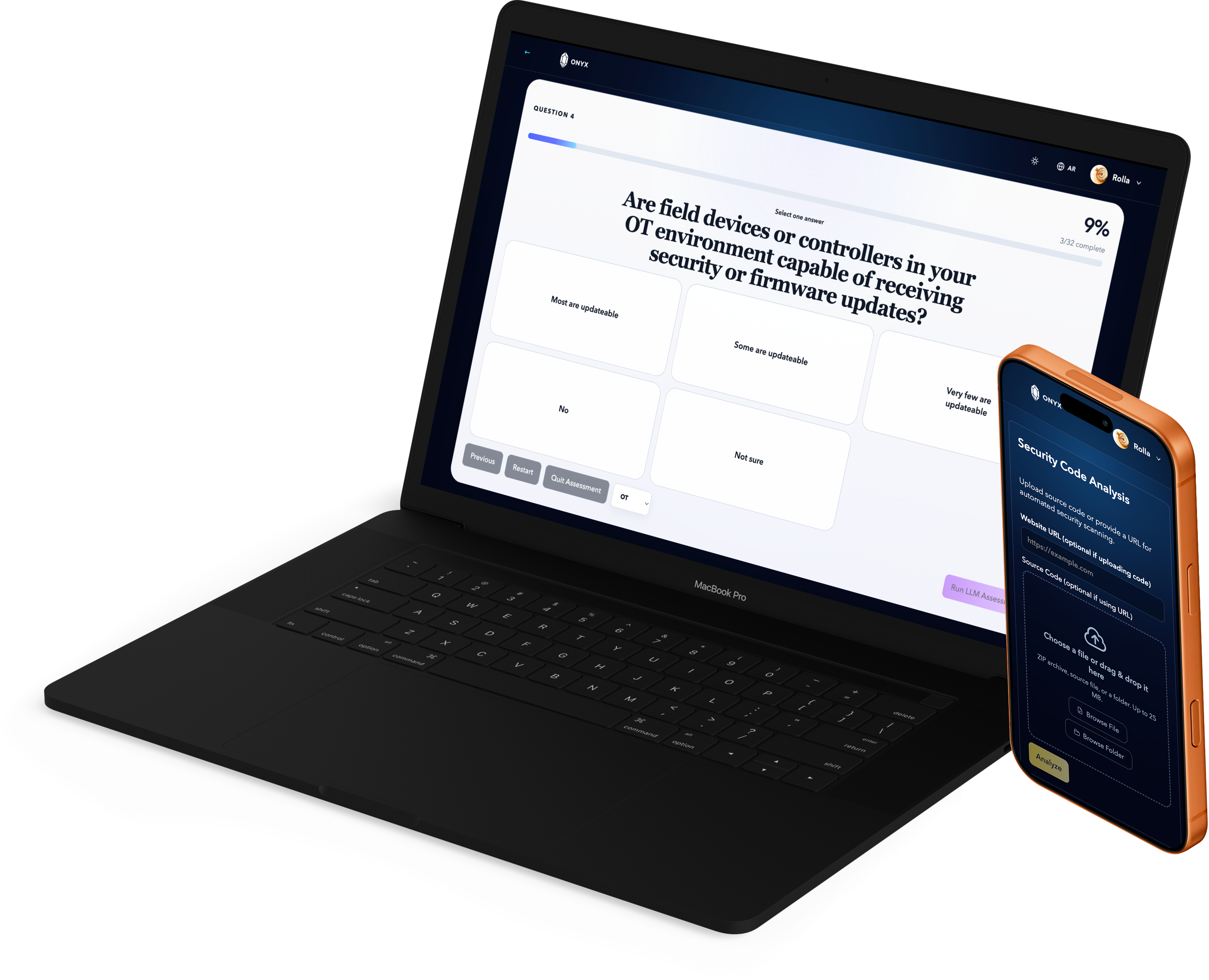
Sandboxed assessment sessions let you test your website or code and get a standards-guided recommendation. Your raw code files and website scan data are not stored after the session.
Check code or a website URL for security and quantum-readiness gaps
Prefer not to upload code? Answer questions and get an AI-powered recommendation.
Supports both IT systems and Purdue-style OT environments.
AI uses summarized assessment signals only, never raw code, scan data, or secrets.
You can explore a defense-in-depth simulation and see how different mitigation layers can strengthen quantum readiness.
You can take a look how defense-in-depth cryptographic flow works when a message is sent from one person to another.


Google warns that quantum threats may arrive sooner than expected by 2029, while NIST has pushed organizations to begin urgent migration toward Post-Quantum Cryptography with milestones around 2030 and 2035. Hence, quantum security is no longer just a prediction, but a migration challenge that must be addressed now. There are a few platforms that clearly address this issue. That is why Onyx connects awareness, assessment, and mitigation in one platform for both individuals and organizations to be ready for the quantum era.
There is a threat known as ‘Harvest Now, Decrypt Later’ (HNDL), where sensitive data can be collected today and decrypted later once powerful quantum computers become available. This means the risk does not start only when quantum computers arrive. Preparation also takes time; organizations need to identify where vulnerable cryptography is used, understand which systems are exposed, and prioritize what matters. This is especially true for legacy IT and OT environments, where it is a multi-year proactive process to upgrade. Additionally, 48% of surveyed organizations are unprepared, as reported by Keyfactor in 2025. This shows that there is a clear readiness gap, and simultaneously, NIST’s transition guidance signals that widely used public-key algorithms such as RSA and ECC are moving toward deprecation around 2030 and disallowance by 2035.
Quantum risks do not only affect traditional IT. Critical infrastructure often includes OT and ICS environments that rely on legacy systems, long maintenance cycles, and protocols that are difficult to patch or replace. While many OT protocols do not include built-in encryption, cryptography still exists around OT through VPNs, TLS, certificates, remote access, data historians, engineering workstations, HMIs, gateways, and firmware updates. Onyx assesses both IT and OT exposure early so organizations can discover cryptographic dependencies, understand where defense-in-depth is needed, and plan post-quantum migration before quantum threats become urgent.
Yes, but a general AI agent depends on you knowing exactly what to ask. Thus, if you are unaware of quantum-security risks, you may miss important issues in your code, website, cryptography, OT environment, or migration plan. In fact, according to ISACA, 37% of organizations have not discussed quantum computing at all, while 24% do not know how their organization views it. This becomes even riskier with the rise of vibe coding, where code can be generated quickly without always considering long-term security risks. Onyx is built specifically for quantum readiness. It guides you through the areas that matter, identifies weak points, provides standards-aligned recommendations, and suggests practical mitigation steps with a clear migration timeline. Instead of starting from a blank prompt, you can simply upload source code, enter a website URL, or answer a structured set of questions. Onyx is also especially relevant for OT environments, where systems are safety-critical, legacy-heavy, and cannot be treated like normal software projects. It is also designed with privacy in mind, so assessments can be completed without sending raw code, website data, or assessment details to a general AI chatbot.
Our platform proposes a defense-in-depth approach that users can benefit from. We do not replace ML-KEM or ML-DSA, which are standardized post-quantum mechanisms for key exchange and digital signatures. In real systems, especially in legacy systems, IT and OT systems, migration to PQC is not easily supported because of performance, memory, bandwidth, and compatibility challenges. Hence, Onyx supports both modern and legacy IT and OT environments, by reducing exposure while preparing for full post-quantum migration.
Seen enough of what Onyx can do? Come aboard and join Onyx to get a look at the platform, explore the assessment experience, and start preparing early.
Have a question or collaboration idea? Feel free to drop us a message.